
Predictive Maintenance System for Industrial Equipment
Context
Industrial equipment generates continuous streams of sensor data, including vibration, temperature, pressure, and operational signals. While this data contains early indicators of potential failures, it is often noisy, high-frequency, and difficult to interpret in raw form.
Maintenance strategies were primarily reactive or schedule-based, leading to unexpected downtime, inefficient maintenance cycles, and increased operational costs.
The objective was to design a predictive maintenance system capable of detecting early signs of equipment degradation, while remaining reliable, explainable, and suitable for real-world industrial environments.
System Architecture
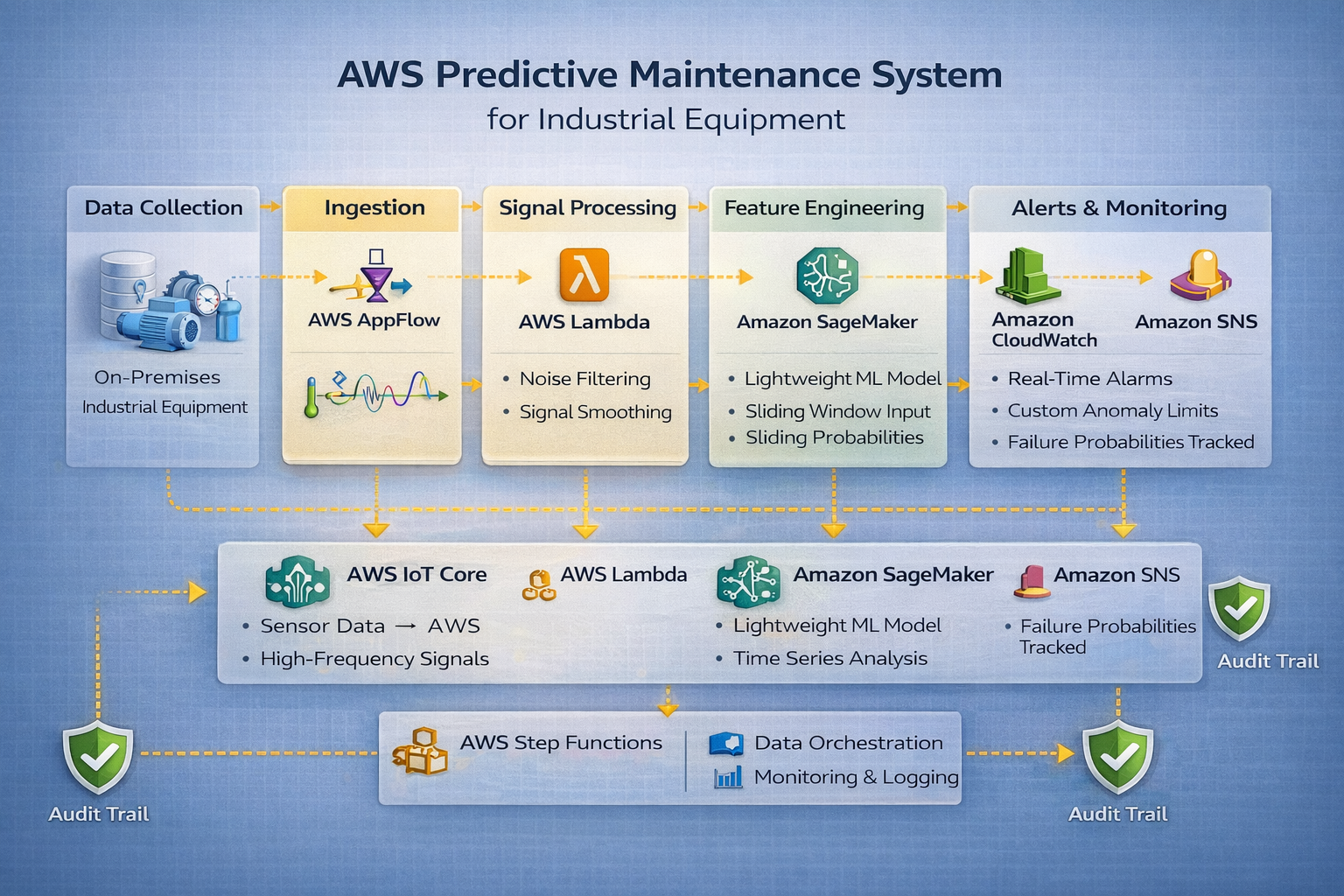
The system was designed as a modular, cloud-native pipeline on AWS, optimized for time-series data processing, model stability, and operational monitoring.
- Data Sources: On-premises industrial equipment equipped with sensors generating high-frequency telemetry data.
- Data Ingestion (AWS IoT Core / AppFlow): Sensor data is securely ingested into AWS using managed services, supporting batch and near-real-time ingestion patterns.
- Signal Processing (AWS Lambda): Incoming signals are filtered, normalized, and cleaned to reduce noise and handle missing or corrupted readings.
- Feature Engineering: Sliding window aggregations are applied to extract statistical and temporal features that capture equipment behavior.
- Model Inference (Amazon SageMaker): Lightweight machine learning models generate failure probability scores based on recent equipment behavior.
- Monitoring & Alerts: Predictions are monitored using Amazon CloudWatch, with alerts delivered via Amazon SNS when risk thresholds are exceeded.
Key Engineering Decisions
- Traditional machine learning models were selected instead of deep learning due to limited labeled failure data and the need for stable, interpretable predictions.
- Sliding window feature extraction was chosen to balance responsiveness with signal stability.
- Signal preprocessing was treated as a first-class component, recognizing that data quality had a greater impact than model complexity.
- Precision was prioritized over recall to minimize false alarms that could disrupt maintenance operations.
- Model outputs were continuously monitored to detect drift and performance degradation over time.
Outcome
The predictive maintenance system enabled early detection of potential equipment failures, allowing maintenance teams to intervene before critical breakdowns occurred.
False alarms were significantly reduced, increasing trust in the system and adoption by operational teams.
The solution provided a scalable foundation for expanding predictive analytics across additional equipment and industrial assets.